
After successful research…..Colored cotton will be produced in Syria
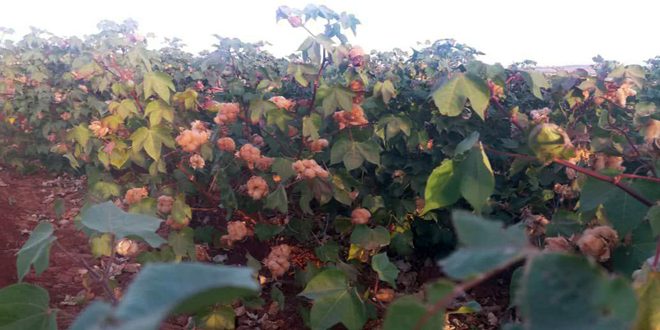
Director of the Cotton Office at the Ministry of Agriculture and Agrarian Reform Dr. Ahmed Al-Juma’a revealed that work is underway to develop colored cotton to be available to farmers during the next two years, and the focus will be on growing organic cotton for its great competitive advantages.
“ The General Commission for Scientific Agricultural Research (GCSAR) has developed colored cotton with satisfactory results after nearly 20 years of research” Al-Juma’a said in a statement to a SANA reporter on the sidelines of a workshop held at Al-Assad National Library in Damascus.
He indicated that this cotton has good competitive features due to its natural colors that are characterized by their stability and importance in improving the quality of the manufacturing process and reducing its costs in terms of dyes and chemicals.
He pointed out that there are three main colors which will be available including brown in four shades, starting from dark brown to light brown, closest to yellow, green and greenish-brown.
Regarding the importance of organic cotton cultivation Al-Juma’a said that with the aim of dispensing with the huge quantities of pesticides, herbicides and fertilizers of chemical origin, which are consumed by the production of this crop in very large quantities and their dangerous effects, the focus has been during the past years in the field of research on organic cotton because it is very desirable in the world for its advantages, noting that its price is 30 to 40 percent higher than regular cotton.
Based on the importance of cotton as a strategic crop in terms of agriculture, industry, production and marketing, Dr. Al-Juma’a called for signing contracts with farmers by the Ministry of Industry and providing all the production requirements.
As for the varieties of cotton that are currently available,Al-Juma’a indicated that they are of high quality, and through scientific research based on the development of varieties derived in Syria, a variety was developed for each governorate that gives the highest production capacity and adapts to its cultivation environment.
With regard to the next year’s plan drawn up by the Ministry of Agriculture, “ it is based on two main parts: the irrigation capacity in the cotton-producing governorates and the annual need of the Ministry of Industry” according to Dr. Al-Juma’a.
RawaaGhanam