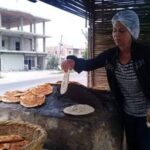
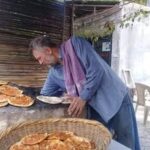
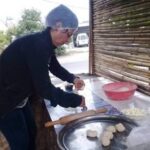
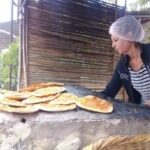
Tannour bread still represents Syrian deep-rooted tangible heritage
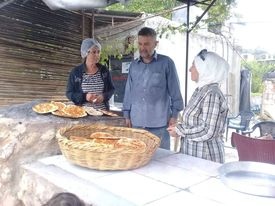
The areas of the Syrian countryside are still rich in many authentic social legacies that still occupy a unique place despite the changes in the customs and traditions of these areas.
The tannour ( tandoor) is an important part of the original Syrian heritage, and most of the countryside still preserve and use it to this day. Women are still mastering the making of tannoor bread, which is one of the most important known customs. There is hardly a house in the countryside without the presence of the tandoor, which has recently witnessed remarkable popularity, not in the countryside, but in most city neighborhoods, on public roads and restaurants.
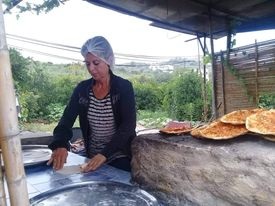 “Despite the development of industry and the advancement of modern machines in bakeries and ovens, this development could not compete with an aspect of the authentic Arab heritage, nor could it match the clay ovens for tannour bread . Previously, tannour bread, which has been known since thousands of years, was the main daily bread in Syria, and it is still made in many parts of the Syrian countryside to this day” Mr. Shadi Naddaf , an owner of a Tannour in Ein Al-Laban village in the countryside of Lattakia said in an interview with the Syriatimes e-newspaper.
Mr. Naddaf stressed that Syria is rich and famous for its civilization and its tangible and intangible heritage, affirming heritage is the identity of society, and tannour is a purely heritage issue that we must preserve.
“We were displaced from Damascus countryside in 2013 due to the terrorist war on Syria. I came to Latakia with my family and worked in cooperation with my wife, whom I consider my major partner in life , in planting , making food homemade products in addition to producing rose water” Mr. Naddaf said.
He indicated that he had a very small tandoor for only his family, but later he made two big pottery and clay tandoors to bake all kinds of pies and grill chicken.
“ I called my tannour , which I have near my house in Ein Al-Laban village, “Tannour Al-Haneen” ( nostalgia) as a symbol of nostalgia for the days of our ancestors when all the family members gathered around the tannour to bake bread and sing old traditional songs in an atmosphere of affection and love” he added.
Mr. Naddaf expressed that previously, the tannour witnessed distinct love stories among family members and social relationships which represented times of joy, love, sadness and hope.
In turn, his wife Mrs. Madeleine Dayoub told Syriatimes “we faced very difficult circumstances when we were displaced, but I did not give up and the crisis did not make me lose hope. On the contrary, I had determination and a challenge to all the difficulties we faced”.
“Hope is a rock on which the impossible is destroyed . We have to live life in all its details. Continuity is very necessary with the spirit of challenge. I used to be always successful and distinguished in my work” according to Dayoub.
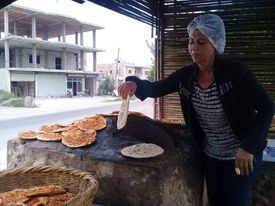 She made it clear that she learnt Tannour bread baking from her mother and her grandparents, as they have practiced this profession for 40 years
The fifty-year-old woman who is head of the Children Department at Al-Assad military hospital in Lattakia, expressed “I am very proud of my work in baking tannour bread and all kinds of pies. I have a special relationship with tannour that reminds me of the most beautiful and enjoyable moments that we spent with our ancestors as we used to gather around it to listen to the most beautiful ancient heritage songs and tales of our ancestors.”
She stressed that tannour is a very important heritage project which we must preserve, revive and introduce to future generations, adding that very few women know how to make tannour bread as it requires several skills, mainly patience and accuracy.
With delicious healthy taste and smell of baking bread and all kinds of pies including cheese, thyme and hot peppers Mrs. Dayoub concluded “Syrian women are ambitious, and had it not been for persistence, they would not remain steadfast and defy circumstances. Women must work and be creative in every field. I support and encourage working women, so my husband calls me a bee. I have unlimited energy to work and give without stopping.
Interviewed by : Rawaa Ghanam
Photos by : Rawaa Ghanam