
A Syrian historian documents the history of the ancient East
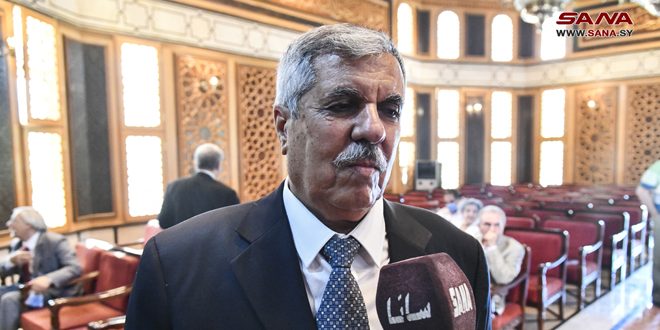
Syrian researcher and historian Eid Marei’s distinguished and valuable researches and studies on the history of the ancient East, its languages and civilizations have enriched the Arab historical and archaeological library.
He believes that history represents the identity and creative mutations are the product of successive eras of ancient civilizations that we must cherish, stressing that he exerted relentless efforts to highlight languages of the Middle East region with the aim of enhancing the role and value of the Arabic language civilization among the languages of the world.
After obtaining a degree in history from Damascus university , the Syrian historian, who comes from the Occupied Syrian Golan, , traveled to West Germany and studied history, heritage and languages of the Mesopotamian civilization until he obtained a doctorate in 1985.
Dr. Eid, who is currently a professor at the Department of History in Damascus University, has taught in a number of Arab universities including Sana’a University , then spent five years at the College of Education in Bisha, Saudi Arabia, and one year at the University of Dammam. He also worked as a visiting professor at the Institute of Oriental Studies at the University of Chicago, USA.
He published researches and studies after his return from Germany in a number of periodicals, including historical studies published by Damascus University and the Cradle of Civilizations periodical issued by the General Directorate of Antiquities and Museums (GDAM).
Dr. Eid wrote many university and non-university studies and books, which mainly focused on the ancient history of Syria, the laws of Mesopotamia, the ancient history of Al-Jazera Al-Arabia, the history of the Kingdom of Ebla and its antiquities, the worship of fertility gods, the calendar, time calculation, and the dictionary of gods and mythical beings in the ancient East.
The Syrian historian searched in the Encyclopedia of Syrian Archeology in Syria’s ancient history, antiquities and civilization from pre-writing times until the Seleucid era. His studies depended on antiquities and ancient writings discovered within Syrian geography and the inhabitants of the neighboring regions who excelled in realizing remarkable civilizational achievements such as discovering agriculture, making pottery, building the first cities, inventing alphabetic writing and knowledge as well as various arts of carving, drawing and decorating.
This was evident in the monuments of cities and ancient archaeological sites, the most famous of which are Ebla, Ugarit and others, which makes us call Syria the heart of the ancient world.
Dr. Eid distinguished presence in the scientific field was manifested by his invitation to participate in international conferences and symposiums held in a number of Arab and international countries in addition to Syria with the aim of highlighting the ancient history of Syria, the Ancient Near East and Al-Jazira.
The distinguished career of Dr. Eid enabled him to win the Muhammad Kurd Ali Prize in Human Sciences from the Arabic Language Academy in Damascus in 2016 for authoring six books and translating one book in addition to the State Appreciation Award in 2018.
Rawaa Ghanam