
Syrian scientific research on intangible cultural heritage wins first place in competition of Italian Santgrata Foundation
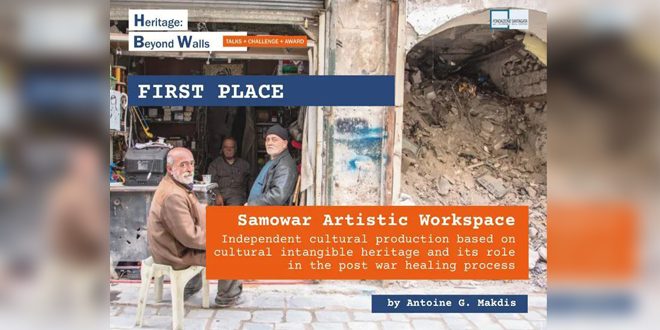
A scientific research by the son of the city of Aleppo, Antoine Makdis, related to how to recover from the effects of war through independent cultural production based on the intangible cultural heritage, won first place in the HBW competition of the Sangrata Foundation, which specializes in Italian cultural economy.
The scientific research also included a proposal for a project entitled “Samowar Artistic Workspace, an independent cultural production based on intangible heritage and its role in post-war healing processes”. It aims at establishing the first artistic workspace in Aleppo located in a traditional Syrian house as a space for cultural workshops with different specializations, in addition to holding exhibitions and events there.
According to Makdis, Samowar artistic workspace is a cultural theater where Aleppian creators can meet, conduct dialogue, learn, discover other cultures and be briefed on all world experiences, in addition to the production of ideas and the revival of traditional crafts in Syria through the reorganization of its industry.
In an interview with SANA, Makdis said that the idea of his research was based on the fact that, after 11 years of war, Syrians lost a large part of their previous lives because the war changed the social and economic structure of society and revealed many cross-generational problems related to culture and accumulated demographic changes.
Makdis pointed out that throughout history, cafés in all cities of the Silk Road, especially in the city of Aleppo, were the cultural and social engine for being a space for individuals to meet, exchange ideas and dialogue, which led to communication and the invention of cultural products similar to society and its needs.
Regarding the reason for choosing the name Samowar, Makdis pointed out that (the samovar) is a machine in which (Khmer tea) is made, and this tea is present in all the cities through which the Silk Road and the East in general pass.
He pointed out that the goal of the “Samowar” project is to create work spaces and experience new experiences, as it is a space for activists in this field who lack the tools and experience to carry out their cultural projects.
Makdis reviewed the societal cultural problems and challenges with their solutions, including immigration, sanctions and the economic siege imposed on the Syrian people, as he sees culture in all its forms as an outlet for overcoming those sanctions.
Makdis underlined the importance of focusing on the intangible cultural heritage through seeing the Syrian heritage with new eyes and creating a space for young people to hear the experiences of the great experts in it. He emphasized the importance of the concept of citizenship based on dialogue and heritage as it is a living movement that does not only mean what we inherited from our ancestors, but also what will be transmitted for the sons.
Makdis concluded his speech by saying, “The city of Aleppo and many Syrian cities, through my field visit to many of them, have a treasure of culture and heritage. This treasure may be a lifeline because of its ability to unite societies and reach sustainable development.”
Inas Abdulkareem