
Sabbagh: Syria is determined to overcome obstacles to return the displaced
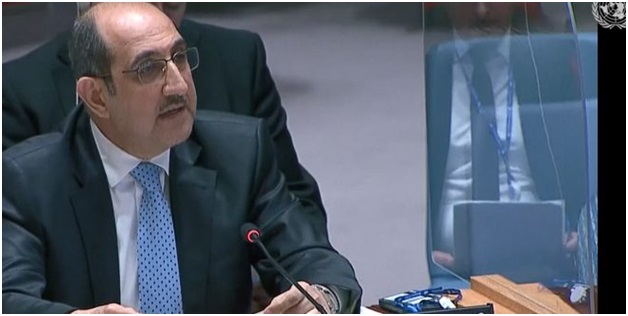
Syria’s permanent representative to the United Nations, Bassam Sabbagh, stressed that the goal of the Israeli attacks on Syrian territory, the crimes of terrorist organizations, and the illegal presence of US and Turkish forces on them is to perpetuate chaos and terrorism and block the path to a political solution.
In a session of the UN Security Council on the political issue in Syria, Sabbagh said: “Syria regrets that the Security Council was unable to condemn the Israeli aggression on Damascus International Airport. It deplores the fact that some countries obstructed the council’s condemnation of this aggression under pretexts that clearly reflect its blind bias in favor of Israel. The Security Council’s failure in discharging its responsibilities makes the UN member states feel that they cannot rely on international legitimacy, but rather on their own capabilities to recover their rights.
Sabbagh affirmed Syria’s commitment to the political solution based on the Syrian-Syrian national dialogue and the political process under the leadership and ownership of Syria without any external interference. He underlined the need to fully adhere to its references and rules of work and reject any external interference in its work or impose predetermined results and artificial timetables for it.
Sabbagh indicated that the countries that prevent Syrian refugees from returning to their homeland should stop placing obstacles that prevent them from returning freely and with dignity, which first requires the lifting of the imposed unilateral coercive measures that kill the Syrian people and cannot be justified in any way.
He noted the extremely important and unprecedented steps taken by the Syrian government in recent months, which clearly demonstrated the firm desire of the Syrian state to support the path of national reconciliations and local settlements, which it has adopted as an approach that has proven its effectiveness in enabling Syrians to return to their normal lives and directing their energies and capabilities towards the process of building Syria’s future and stability.
Sabbagh noted that the amnesty decree issued by President Bashar al-Assad on the thirtieth of last April represented an exceptional step by its legal, social and political nature, benefiting large numbers of detainees and prosecuted individuals inside and outside the country. He asserted that work is still continuing on its implementation, as diplomatic missions abroad opened their doors to receive requests of Syrians wishing to benefit from this decree and provide support to settle their situation.
He indicated that the Syrian state institutions are continuing their efforts to strengthen the legal and legislative structure, develop laws and harmonize them with the current requirements.
Sabbagh considered that holding the fourth meeting to follow-up the International Conference on the Return of Syrian Refugees and Displaced Persons in Damascus clearly reflects the strong will of the Syrian government to continue to overcome obstacles that prevent the safe, dignified and voluntary return of the displaced to their homes and areas of origin.
Syria’s permanent representative to the United Nations pointed out that the final statement of the eighteenth international conference on Syria under the Astana formula, which was held in the city of Nur-Sultan, confirmed on the firm adherence to the sovereignty, independence, unity and territorial integrity of Syria, and the need to continue to work to combat terrorism and confront the organizations of ISIS and Jabhat al-Nusra and the individuals and entities associated with them, including those that represent a threat to civilians inside and outside Idlib de-escalation zone.
Sabbagh added that the statement affirmed rejection of all unilateral coercive measures imposed on the Syrian people and the theft of their resources, and rejection of all attempts to create new conditions on the ground, including the so-called “self-governance initiatives” and separatist projects in the northeast of the country.
Sabbagh indicated that the statement also welcomed the process of mutual release of a number of abductees and detainees that took place on June 13. It also condemned the continuation of the Israeli military attacks on Syria, which endanger security and stability in the region, and demanded their cessation and rejection of all unilateral coercive measures imposed on the Syrian people and the illegal transfers of oil revenues that should return to Syria.
He praised the efforts made by the Russian and Iranian guarantors, in contrast to the Turkish regime, which, through its practices, has reneged on its previous commitments and pledges under the Astana agreements and the Sochi understandings. He reiterated Syria’s rejection and condemnation of its statements regarding the establishment of the so-called “safe zone” in northern Syria, and the continuation of its aggressive policies based on killing, displacement, demographic change and ethnic cleansing under false pretexts that serve internal political purposes to cover up its accumulated crises, which in turn threaten peace and security in the region.
Sabbagh said, “My country is looking forward with interest to the ninth round of the constitutional discussion committee, after the special envoy found a solution to the logistical problems raised by some of the participating parties.”
Sabbagh stressed that the party that Turkey named and claims to represent the Syrians is still insisting on obstructing any progress in the work of the constitutional discussion committee and promoting ideas that contradict the will of the Syrian people and do not serve their aspirations and vision for a better future of peace, stability and prosperity for all. “How can Syria justify the continuation of unilateral coercive measures that every Syrian suffers from in his daily life, and how can a Syrian publicly call for external military intervention in the internal affairs of his country,” he wondered.
Sabbagh asserted that Syria is a sovereign state that is proud of its national and Arab identity and that takes decisions with its national will and based on its constitutional duties and its concern for all its people. It seeks to establish and consolidate relations of friendship and constructive cooperation with various countries of the world in a manner that respects the principles of sovereignty, independence, non-interference in internal affairs, and renounces the use of force, in line with its foreign policy priorities in restoring security and stability and achieving prosperity and sustainable growth for Syrians without exception or exclusion.
Inas Abdulkareem