
World’s Leggiest Animal Found Near Silicon Valley
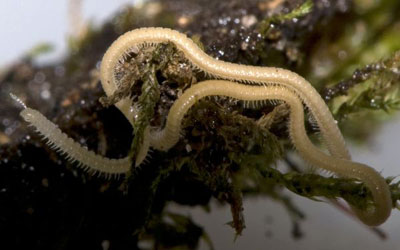

The leggiest creature on Earth lives in California. But it’s not a movie star or a model. In fact, it’s smaller than a human pinky finger. It’s a 3-centimeter-long (1.2-inch) millipede with 750 legs.
First seen by scientists in 1928, Illacme plenipes—”the acme of plentiful legs”—keeps such a low profile that for the rest of the 20th century the species was thought to be extinct. Then University of Arizona entomologist Paul Marek spied one near Silicon Valley.
Marek and colleagues’ new paper—published Wednesday by the journal ZooKeys—offers the first scientific description of Illacme plenipes, including insights into its strange anatomy.
For one thing, females have up to 750 legs, and males have more than 550. Most other millipede species have between 80 and 100 legs apiece, Marek said. For another thing, Illacme plenipes can spin silk from long hairs that cover its back, thereby creating its own “clothing.”
“It’s the coolest millipede I’ve ever heard about,” Marek added.
Illacme plenipes has “kind of had a mythical status among millipede people,” Marek said.
So in 2005, an intrigued Marek—then a doctoral student—began searching for the legendary invertebrate in a foggy 2.8-square-mile (7.3-square-kilometer) area outside San Francisco.
Over three years Marek and his team turned up 17 specimens, each clinging to sandstone boulders. Though they suspected more millipedes might be found, the team stopped collecting specimens in 2007, so as not to potentially deplete the species in the wild.
Because these burrowing arthropods live deep underground, their legs have adapted to include claws. Marek and other researchers hypothesize that these talons may help Illacme plenipes cling to subterranean rocks.
Other surprising anatomical features include massive antennae (relative to the scale of its body), which the millipede uses to feel its way through the dark; a jagged and translucent exoskeleton; and body hairs that produce a sort of silk that may help Illacme plenipes adhere to the undersides of boulders. And unlike in other millipedes, the mouth of this species is specifically structured for piercing and sucking plant tissues.
But Marek said Illacme plenipes does have at least one thing in common with other millipedes: a name that’s “sort of a misnomer.” No millipede has ever been known to have a thousand legs, he said (though he concedes that a species with that leg count may exist.
Now that Illacme plenipes has been rediscovered, how much longer does it have left?
Constant development in the area is destroying its habitat, Marek said. It would be a shame, he added, for this “bizarre” species to vanish again before we can learn more about it.