
Ambassador Khaddour: Syria is developing its national laws in line with international conventions on crime prevention
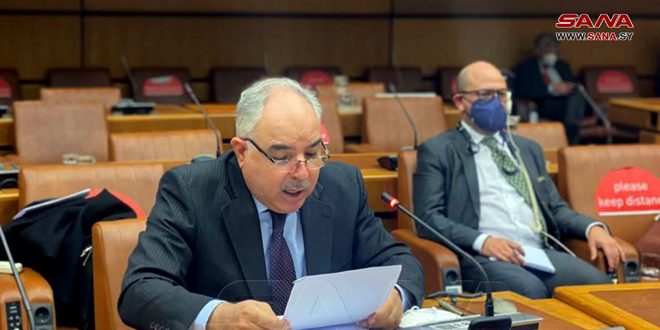
Syria’s permanent representative to the United Nations office and other international organizations in Vienna, Ambassador Dr. Hassan Khaddour, affirmed Syria’s keenness to develop its national laws in line with international conventions on crime prevention, pointing out that what is worrying is the ability of terrorist and criminal elements to own and use modern means of communication to carry out their crimes and provide for an arena for promoting hate speech and human trafficking.
Ambassador Khaddour said, in Syria’s statement delivered at the thirty-first session of the Commission on Crime Prevention and Criminal Justice, that Syria is a party to most of the international instruments concerned with crime prevention and is keen to update and develop its national laws in line with these international conventions. That is why, during the past years, the Syrian government issued a package of laws, including combating money laundering, preventing the financing of terrorism, kidnapping, detaining freedom, combating information crimes, banking secrecy, combating drugs and illegal immigration, in addition to making efforts to enhance collective awareness of the seriousness of these crimes, building national capacities and raising the level of their qualification.
Ambassador Khaddour pointed out that President Bashar al-Assad recently issued Law No. 20 of 2022 to reorganize the criminal legal rules for information crime. The law aims at combating information crimes in line with the technological development and the high rate of information crimes and its rapid spread in society. The law aims at protecting the legal interests, regulating freedoms in the virtual world and limiting abuse of technical means.
Ambassador Khaddour pointed out that the Syrian National Committee on Combating Trafficking in Persons has prepared a national plan covering the period 2020-2022 and aims to draw up a comprehensive policy to prevent trafficking in persons through raising awareness, protecting victims, providing assistance to them, prosecution of crime, international cooperation and building partnerships.
Ambassador Khaddour stated that Syria was ranked third in the world in terms of the absence of transnational organized crimes in it, but unfortunately this situation has changed during the past 11 years, which witnessed the entry of large numbers of the most dangerous terrorist and criminal elements into Syria from various countries of the world supported by regional and international parties who provided them with money, weapons and modern means of communication.
Ambassador Khaddour pointed out that these criminal terrorist groups have permitted the practice of all forms of crimes, including human and organ trafficking, sexual exploitation, destruction and looting of Syrian antiquities from more than 900 archaeological sites, many of which date back more than two thousand years, as well as the theft of heritage monuments, including the holdings of churches and mosques. and smuggling these items out of the country and using the outcome of the sale to finance terrorist operations.
Ambassador Khaddour explained that the repercussions of the terrorist war and the imposition of unilateral coercive economic measures imposed on Syria by the European Union and the United States of America led to waves of population displacement to the lands of neighboring countries, as well as child labor and trafficking in underage Syrian girls.
Ambassador Khaddour stressed that these crimes require the development of a serious and immediate plan of action to protect the Syrians residing in camps and help in returning them to their homes and lifting illegal measures in a way that helps provide living and development conditions for them.
Ambassador Khaddour pointed out that what is worrying is the ability of terrorist and criminal elements to own and use modern means of communication, including the use of social media programs as a means to carry out their crimes, and to provide for an arena for promoting hate speech, human trafficking, selling looted antiquities, and publishing detailed instructions on how to plunder such sites in order to facilitate their crimes, identify the required archaeological sites and loot their treasures. The terrorist and criminal elements are exploiting these capabilities to commit cybercrime. Unfortunately, this is done in full view of the governments of UN member states, especially those states that enjoy the electronic technology and keep it to themselves.
Ambassador Khaddour warned that the failure to ward off these dangers, prevent the consequences of their erroneous use and secure full protection from them, requires all countries to assume their responsibilities and to strengthen cooperation on the necessary control and prevention measures, in addition to working with the relevant international organizations to ensure the protection of the rights of member states, where the role of the United Nations emerges here side by side with the role of the United Nations Office on Drugs and Crime in particular to provide the necessary support and technical assistance to the affected countries.
Ambassador Khaddour stressed that Syria attaches great importance to close cooperation with the United Nations Office on Drugs and Crime in Vienna, and appreciates the efforts this Office exerts in providing technical support to member states. Therefore, Syria looks forward to the Office’s further involvement in work and cooperation with Syria, especially in light of the circumstances Syria has been exposed to since 2011. Ambassador Khaddour renewed the invitation to the office for a field visit to Syria to take a look at the current reality, assess the volume of needs, and suggest ways to activate joint cooperation.
At the conclusion of his speech, Ambassador Khaddour pointed out that strengthening the role of the United Nations in confronting organized crime is an urgent need for members of the international community to bear the participatory responsibility in this regard, and the need to accompany it with a sincere political will in the full implementation of the relevant international conventions and resolutions in order to be effective in confronting organized crime, combating terrorism and extremist ideology, and drying up its funding sources.
NR