
Syrian antiquities with Dutch vision adorn the National Museum wall in Damascus
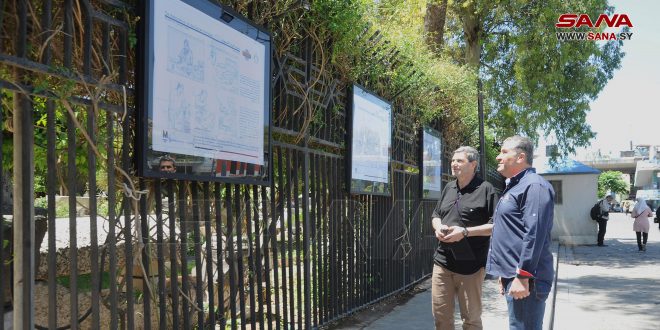
To show his love and passion for Syria, its history and heritage, Dutch archaeologist and artist Theo de Vitte returned after 36 years to decorate the garden of the National Museum in Damascus with his paintings that depict its archaeological sites, inspired by the ability of its people to live and rise despite the calamities and difficulties they experienced.
The exhibition that adorned the museum wall with the title, “Restoration of Syrian Heritage with the Vision of Theo Vitte”, included 15 works composed of drawings and paintings by the Dutch artist of Syrian antiquities during his trip to our country from 2019 to 2021, such as the Grand Mosque of Aleppo, Qal ‘at al-Hosn and the Mamluk Palace in the old city of Homs, and the Temple of Bel in Palmyra. He pointed to the great efforts of Syrian archaeologists to restore what was destroyed by the war, documenting the tremendous progress achieved in the restoration of Syria’s heritage as well as new excavations by local and foreign teams.
The exhibition was accompanied by issuing a booklet in which he documented Syrian archaeological activities over the past four years in several places and from different time periods, taking into account the difficult circumstances surrounding these activities, influenced by his personal motivation and passion for our monuments.
In a statement to SANA, Minister of Culture Dr. Loubana Mouchaweh, confirmed that the Dutch archaeologist and artist, who loved Syria, had worked in it since 1985 as an archaeologist, where he learned about the reality of its civilization and its people. When he returned to it in 2018 he was shocked by the destruction he saw in the sites he knew and decided to immortalize these scenes and paint what they would become later after they were revived.
Dr. Mouchaweh considered that the exhibition is a historic document for the Syrians and for the West that illustrates to the world the suffering experienced by our country and the violations perpetrated by terrorism against its ancient heritage. It also shows our efforts as individuals and institutions to restore Syrian antiquities and civilization and the need to safeguard them for generations and all humanity.
Artist De Vitte stated that the main objective of the exhibition was to show the important restoration work that took place in Syria, illustrating Syria’s cultural heritage, as well as some archaeological sites where excavation and restoration are taking place. He hoped that another exhibition would be held in Aleppo, in addition to a number of European countries, particularly in the Dutch city of Amsterdam, with the aim of informing Western communities about the important work being done by the Directorate of antiquities, museums and institutions involved in the restoration of Syrian cultural heritage during previous periods.
Director General of Antiquities and Museums Nazir Awad pointed to the importance of this exhibition that was held by a Dutch artist who worked in Syria for many years. He began to paint the surrounding scenery and then moved on to depict the Syrian archaeological sites and their devastation, especially in Palmyra, illustrating to Europe the reality of violations that the Syrian antiquities had experienced.
These paintings will be displayed, according to the Director of Antiquities and Museums, in a number of European galleries, as well as a small brochure on the exhibition showing the systematic destruction of the Syrian cultural heritage will be issued.
Amal Farha