
“The Journey of the War in Syria” A new book by an Argentinian writer
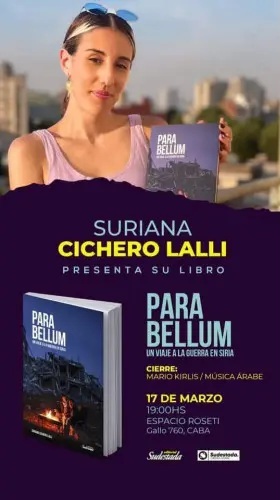
In her book “The Journey of the War in Syria”, signed in the capital of Argentina, Buenos Aires, Suriana Cichero Lalli reviewed the lives of many Syrians during her visit to Syria which lasted seven months during which she witnessed the real life in Syria contrary to the misleading western media, according to the e-Syria Reporter Betty Farah .
Suriana Cichero Lalli was born to a Syrian mother and an Argentinian father. She studied political science and web design. Since her childhood, her mother instilled in her memory a lot about “Syria” and its civilization, and after years of war, she decided in 2018 to travel to Syria to document the real condition.
She visited some liberated areas and toured “Damascus, Yabroud, Al-Nabek, Homs, Tartous, Lattakia, Sweida and Daraa”, as well as a number of archaeological sites such as “Sednaya” and Maaloula.
“Public opinion abroad is ignorant of the whole truth, as it showed what happened in Syria as a “civil war”, in an attempt to obliterate the real situation” Cichero Lalli said , stressing the war’s primary goal was to control natural resources and also because of the Syrian stand in support of the Palestinian cause.
In her book, Suriana described the relationship between the Syrian army and the people as a fraternal relationship, indicating to the reporter “You may find a group of people from one house who support the army in its missions so that security will prevail in the streets and neighborhoods, so a I decided to move forward in writing to clarify what actually happened.”
During her visit to Syria, Suriana met many people, most of whom interacted with her and reviewed their bitter experience in the war including, kidnapping and killing by the terrorist groups.
As for the beautiful moments that she experienced in “Syria”, she said: “The bad economic situation did not affect the customs of hospitality and generosity. Everyone treated me with love as if I were their daughter. These struggling people who love life and refuse to accept the term “victim” have affected me. They are an extension of a great history and civilization.”
She highlighted “My mother instilled everything that is beautiful about Syria and its civilization. During the war, we were following the official Syrian channel, and in support of the Syrian people, I tattooed the word “resistance” on my hand.”
During her visit to Syria, the Argentinian author met with a number of Syrian women whom she described as creative and strong-willed.
She pointed out that “The Syrian woman in general and the mother in particular was a fighter of a special kind, shouldering responsibility in the absence of the husband who was supporting the Syrian army” affirming “Syrian” women will be the heroines of my book.”
Concerning the interaction of the Argentine people with the book, she pointed out that the book found a positive echo in the street and the readers interacted with its stories, through a radically different narrative from the media.
Suriana stressed the book achieved its objective in conveying many details, the most important of which is the will of the Syrian people, who are still insisting on life.
“I traveled to Syria to find my Syrian identity, or my other Syrian half. I loved to get out of the circle of childhood stories that my mother used to tell me about Syria” the author said.
“My journey would be a link with my mother’s land. I always tell my friends proudly about my Syrian blood. I will visit “Syria” again, and perhaps with new events on my next visit, there may be a new book.” Suriana concluded.
Rawaa Ghanam