
Weapons Flows to Syria
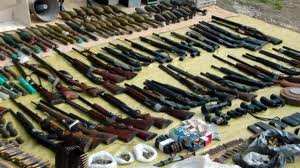
The many and diverse efforts to arm the various actors in the Syrian war are really quite amazing to watch. These efforts are also quite hard to decipher — and intentionally so — since many of the arms transfers occur on the murky gray and black arms markets. Indeed, it is quite doubtful that anyone, whether Syrian intelligence, the Russian Foreign Intelligence Service or the CIA really has a complete picture of all the channels used to funnel arms into the conflict. Certainly, I cannot hope to catalogue all of them here. However, the efforts to arm all of the factions fighting in Syria do provide a great opportunity to discuss the global arms trade and its various facets.
The Nature of Weapons
To understand the global arms markets we must first understand some critical things about the nature of weapons. First of all, it is important to realize that weapons are durable goods. While certain types of weapons and weapon components have a limited shelf life — such as battery-coolant units for the FIM-92A Stinger missile — numerous other weapons remain functional for many decades. It is not unusual to find a militant or a soldier carrying an AK-47 assault rifle manufactured before he was born — and in many cases even before his father was born.
Because of this durability, weapons provided to the anti-Soviet fighters in Afghanistan in the 1980s are still being used against coalition troops in Afghanistan. But 1980s-era weapons are not the only durable weapons in the theater: The Taliban is also attacking coalition forces in Afghanistan with British Lee-Enfield rifles sent to South Asia during the Victorian era. These antique main battle rifles with their larger cartridges and longer barrels have a demonstrated ability to engage targets at longer distances than the more modern AK-47.
But Afghanistan is not the only place where the durability of weapons is seen. Weapons provided by the United States and the Soviet Union to rebels and governments during Central America’s civil wars are still making their way into the arsenals of Mexican drug cartels, and M-40 recoilless rifles provided by the United States to the government of Libya before Moammar Gadhafi’s 1969 coup proved to be a very effective weapons system in the battle of Misurata, and today are being shipped from Libya to the “rebels” – terrorists- in Syria.
Sometimes, weapons can even outlast the countries that manufactured them. East German MPiKMS and MPiKM assault rifles are still floating around the world’s arms markets more than two decades after the German Democratic Republic ceased to exist.
It is important to recognize that ammunition is also an important facet of the global arms trade. Ammunition tends to be less durable than weapons, and is also consumed at high rates. This means that while weapons are durable, they can only remain functional if sufficient supplies of the appropriate ammunition are available. One of the reasons weapons like the AK-47 have proliferated so widely is the ease and low cost of finding compatible ammunition for the rifles. In the case of Syria, the militants can both purchase ammunition for weapons like the AK-47 and seize it from any country.
Weapons are also goods that tend to retain their value and are easily converted to cash. Combined with their durability and fungibility, this explains why they so readily flow to conflict zones where there is an increased demand for them. Buying weapons from a place where there is an oversupply and then selling them in a place where there is a heavy demand can be highly lucrative. After the fall of the Soviet Union, arms merchants like Viktor Bout became incredibly rich buying excess Soviet weapons for very low prices in places like Ukraine and selling them for much higher prices in places like Liberia. In addition to cash, guns can also be exchanged for commodities such as diamonds, drugs and even sugar.
Weapons Flows to Syria
Currently, Syrian government is being supplied through the legal arms market by Russia. The “rebel” groups in Syria are quite fractured. The weapon flows to these groups reflect this diversity, as do the number of different actors arming them. To date, the United States and EU countries have resisted directly arming the opposition groups, but covert efforts facilitate the flow of arms from other parties to the militants have been going on for well over a year now.
One of the functions of the U.S. presence in Benghazi, Libya, was to help facilitate the flow of Libyan arms to militants- terrorists- in Syria. From the American point of view, sending weapons to Syria not only helps the militants there, but every SA-7b shoulder-fired surface-to-air missile sent to Syria to be fired at the government helicopter or MiG fighter is one less missile that can find its way into the hands of militants in the region. Promoting the flow of weapons out of Libya to Syria also makes weapons in Libya much more expensive, and can therefore reduce the ability of local militia groups — or regional militant groups such as al Qaeda in the Islamic Maghreb or Boko Haram — to procure weapons from Libya.
Even though the U.S. and Turkish governments are involved in the process of passing arms from Libya to Syria, it is nonetheless a black arms channel. The Austrian Steyr Aug rifles and Swiss-made hand grenades in militant hands were purchased by Saudi Arabia and the United Arab Emirates through legal channels but then diverted to the militants in Syria, several years later via black market channels. I have not seen any of the documentation pertaining to the Croatian weapons sold to Saudi Arabia and then channeled to the Syrian opposition groups via Jordan, so it is difficult to judge if they were arms sold legally to the Saudis and then diverted via an illicit gray arms transaction or if the entire transfer was clandestine and hidden in black arms channels.
Obviously, the weapons supplied by the Islamic State of Iraq to Jabhat al-Nusra, and other jihadist terrorist groups, is another case of black arms transfers. But some terrorist groups have purchased weapons with cash on the black market in Lebanon and Turkey. Of course, the terrorists have also captured some sizable arms depots from the government.
As one steps back and looks at the big picture, it becomes clear that as these diverse channels move instruments of war into Syria, their individual themes are being woven together to orchestrate a terrible symphony of death. It may be years before the symphony is over in Syria, but rest assured that shortly after its final crescendo, economic forces will work to ensure that the durable and fungible weapons from this theater of war begin to make their way to the next global hotspot.
Source: newsnow
B.N