
Zita, “The Miraculous Cave” was the first to emerge from the womb of the Earth
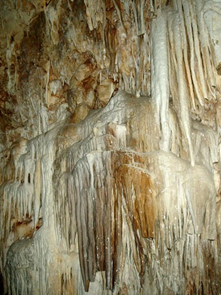
Zita Cave a multi-winged natural museum that the visitor finds in the Al-Aqrabiya Cave of the Maqale’ Mountain, is about 13 km west of the Al-Qusayr city. It was discovered about 12 years ago during the operations of supporting the Zeta Dam.
It is one of Syria’s best-known and most beautiful caves which was found on August 22, 1995 during some rock-blasting operations at a site that was set up to construct a surface water dam near the town of Al-Qusayr in Homs.
According to geologists, this cave is one of the oldest so far discovered in the Mediterranean basin, as it is thought to have accompanied the extinction of dinosaurs 100 million years ago, according to the Remote Sensing Authority. This age will change the geologic concepts of the Earth, where it was established that the first part of the land surface appeared was this area after the cracking of the Earth and the emergence of the Mediterranean Sea. Scientists who have visited the region believe that the crack and the land around it are among the first to emerge on Earth at the formation of the world’s major continents.
Al-Qusayr Cave belongs to a type of cave called “fossil point caves” because they are created through the infiltration of rainwater or springs through lime-rich stones in the subsurface of the earth or mountains. Over time chemical reactions leading to calcification in multiple and strange forms may be accompanied by deposits of other colored salts that give these forms multiple colors besides the strange formation.
The cave is about 15 kilometers west of Al-Qusayr on the Lebanese-Syrian, and 30 kilometers away from Homs in the village of Zeta.
The most important feature of the cave is its wide door, which is more than 7 meters and 3 meters high, in addition to its main hall, which is up to 100 meters wide, 25 meters wide, and 15 meters high.
There are many stunning, colorful stalagmites and stalactites inside the cave and sculptures can be seen in their various forms and dimensions, besides the wonderful shapes of swords or heads.
With regard to the sections of the cave, there are vaults and other small caves going south or east in relation to the main hall.
Those caves are well ventilated with an appropriate humidity, their temperature is moderate, and there are some small pools of pure fresh water.
Before entering the Al-Qusayr Cave, the visitor sees its main entrance, which resulted from the explosion. As soon as he enters the naturally illuminated part, he has to descend a few meters over the rocky rubble caused by the explosion, whether from stalagmites or stalactites. This rubble looks like shattered glass with sharp edges, about 10 meters away.
The visitor then meets a group of stalagmites beautifully arranged side by side. If he continues to descend further on the edge of the lower slope, he will find spectacular formations in the form of real brown or white waterfalls that remind him of the minarets of mosques or the towers of churches, matched from the ceiling by a vast number of stalactites, ranging in diameter from a pencil to a large tree.
He has to imagine as he contemplates the ceilings, walls and shapes of frozen water under his feet as many faces, masks and natural formations as he wants. Where he turns his sights, he has different views competing in their creativity, like he is touring halls of a multi-winged archaeological museum that made his exhibits out of one material; “Calcite,” but in various forms, and appearances, which allows his imagination to go free, to imagine the likeness of these shapes from his vision and memories. He imagines them as flowers, animals, temples, curtains or chandeliers cast from roofs.
The cave is very similar to the “Jeita” cave in “Lebanon” in terms of the shape of stalagmites and stalactites. It extends inward for a distance of 150 m with wonderful and breathtaking views of stalagmites and stalactites and stones of unique shapes. However, it is distinguished from the “Lebanese Jeita” cave with two things. The first is that, according to the report of the geophysical study of the “Zeta” cave area and the determination of the safety status developed by the General Organization for Remote Sensing, it was found that it dates back historically to a 100 million years ago, while the “Jeita” cave in Lebanon dates back to 20 million years ago. The second thing is that the space of the “Zeta” cave is larger than the “Jeita” cave in Lebanon.
The “Zita” cave would become “Jeita” of Syria if it received the required attention from the responsible authorities in terms of project implementation, restoration, and promotion, especially since the Lebanese are seeking to place their “Jeita” cave on the list of wonders of the world.
Amal Farhat