
US intervention in Syria might have grave consequences – Dempsey
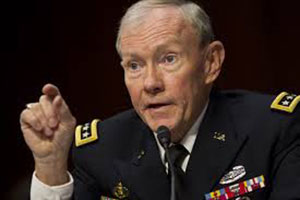
The Pentagon has for the first time unveiled details of several variants of a military intervention in the crisis in Syria. They are recorded in a letter, which Chairman of the Joint Chiefs of Staff of the US Armed Forces, General Martin Dempsey sent to the Senate on July 22. Chief of Staff of the United States stated that all military options were already handed to the President.
Among the developed plans there are deliveries of weapons to ‘militants”, remote air strikes on government troops, creating a no-fly zone over Syria, creating buffer zones on the Syrian borders with Turkey and Jordan, and, finally, using commandos in order to capture “chemical weapons”.
In principle, there is nothing new. All these plans were mentioned before. Though, it is interesting, why they were made public, in what form and with what comments.
The three-page letter from General Dempsey became a response to the threat by Republican Senator John McCain. The chief apologist of a military intervention in Syria has threatened to block the approval of the general for the highest military post of the United States if such plans were not presented within the next few weeks. Dempsey and McCain have long been experiencing personal dislike for each other. Three days before the publication of the letter, they had a very sharp cut and thrust in the Senate.
American generals seldom give political assessments of the Pentagon plans. But this time Dempsey stepped aside from the unspoken rules and added harsh political comments to the letter. “Proceeding to action, we must be prepared for the things that will follow”, Dempsey said. “It will be difficult to avoid the extension of the intervention. We may unintentionally strengthen the extremists or cause the use of “chemical weapons”, which we want to take under control”.
Sometimes the use of military force may be followed by unexpected consequences, and the situation may change for the worse, General Dempsey said.
“I’ve given those views to the President. We’ve given him options that members of this committee have been briefed on them at a classified serving. We have calculated the risk. The decision on whether to use force is the decision of our elected officials”.
In his letter Dempsey hints that the intervention in Syria will automatically create a second Afghanistan or Iraq for the US. According to the Pentagon’s calculation, appropriations for any of the presented options of military actions in Syria will be from $ 500 million a year (simple deliveries of weapons and training of insurgents) to a $ 1 billion a month. The White House would prefer not to go to such expenses against a background of budgetary economy.
Meanwhile, after the negotiations of July 22 in Moscow with Syrian Vice-Premier Qadri Jamil, Minister of Foreign Affairs of Russia Sergey Lavrov reiterated that it was impossible to resolve the situation in Syria by military means.
“We assure everybody in the necessity of approving as soon as possible a Russian-American initiative on convening an international conference on Syria without any preconditions. Unfortunately, so far, – in contrast to the government of Syria – a significant part of the opposition, including the “National Coalition, does not show this willingness. We know that your government is open for dialogue with opposition forces and urge you to go on with these efforts, so that none of the constructive opposition groups was outside the scope of the participants of the hopefully forthcoming conference”, Lavrov said.
Source:Voice of Russia
R.Sawas