
Syria’s pharmaceutical industry struggling to overcome the challenges imposed by the Western coercive measures and the terrorist war
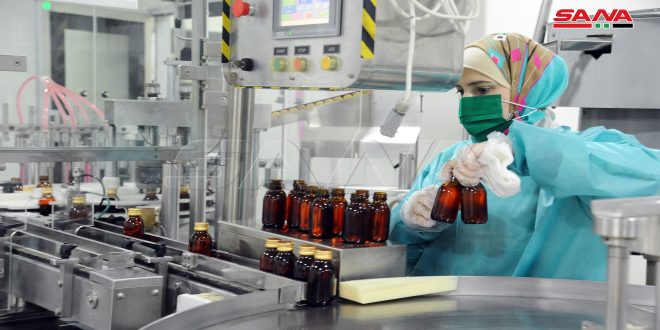
Before the crisis, the pharmaceutical industry in Syria used to cover 93 per cent of the local market’s need and export its products to 54 Arab and Foreign countries.
This situation has greatly changed after the eruption of the terrorist war on Syria in 2011 and it has been worsened after the imposition of western coercive measures that massively affected all sectors, mainly health.
Syria’s pharmaceutical industry has been struggling to overcome the challenges imposed by the Western coercive measures on the country and to alleviate the impacts of the terrorist war that targeted the industrial sector in general.
The government institutions have been providing every possible support for this important industry to attract investors. They have taken some supportive measures in a bid to restore the prosperous past of the Syrian pharmaceutical industry.
Medyan Diab, Director General of the Syrian Investment Agency, told SANA that the agency is keen on meeting the needs of all the factories of raw materials to produce medicine locally. In this regard, it has lisenced several pharmaceutical investment projects with an annul production capacity of 11,000 tons. They will be implemented in cooperation with the ministries of health and Industry to extract and manufacture pharmaceutical salts in Homs. The aim is to meet the needs of the local factories and reduce their dependence on imports.
Diab stressed the importance of issuing the new Investment Law No. 18, which provides facilitations, advantages, incentives and tax exemptions with the aim of creating a competitive investment environment to attract capital, benefitting from expertise and various specializations, expanding the production base, increasing job opportunities and enhancing economic growth that leads to comprehensive and sustainable development.
He pointed out that 17 health, medical and pharmaceutical projects were proposed for investment between 2017 and 2020 with a cost of more than 16 billion Syrian pounds. These projects, which will be carried out in Damascus countryside, Lattakia, Homs, Tartous, Sweidaa and Hama, will create at least 2000 job opportunities after they are accomplished.
Three of these projects have been implemented in Lattakia and Tartous, according to Diab.
On his part, Dr. Rashid Al-Faysal, Head of the Scientific Council of the Syrian Pharmaceutical Industries, said that the sector of pharmaceutical industries in Syria is facing many difficulties, the harshest of which is the unfair siege imposed on the country, that has caused a rise in the prices of raw materials, packaging materials and control devices in the countries of orgin, in addition to a rise in the costs of shipment and in customs.
He added that 70 pharmaceutical factories are currently working in Damascus Countryside, Aleppo, Homs, Hama, Tartous and Lattakia to meet the local market’s need, as they manufacture all kinds of medicine and medical products, except cancer drugs and hermons.
He pointed out that 10 factories, mostly in Aleppo, are currently out of service, because of the damage caused to them during the crisis.
“We are working hard in cooperation with government parties to help these factories re-operate and return to production.
He also indicated that 20 licensed factories are getting ready to launch production, noting the difficulties facing exportation.
Hamda Mustafa