
Syria and Russia: Continuing efforts to return the displaced to their liberated areas
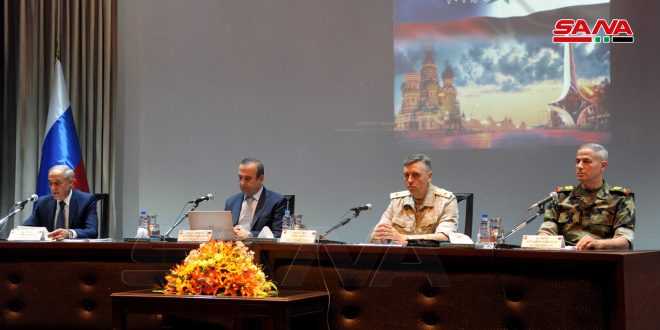
The Minister of Local Administration and Environment, Hussein Makhlouf, presented at the joint Syrian-Russian press conference in Damascus today the Syrian state’s measures to return the displaced to their areas, by creating a legislative environment conducive to their return, settling legal conditions, and issuing amnesty decrees.
Minister Makhlouf pointed to the direct follow-up that President Bashar al-Assad attaches to the productive industrial sectors through his field visits and his direct meeting with industrialists, in addition to the issuance of the new investment law with the aim of creating an investment environment and expanding the production base in parallel with the continuation of work in the 159 modernized and rehabilitated industrial and craft zones with the restoration of commercial and craft markets in city centers, water pumping into the Maskanah water station in Aleppo, the reactivation of 12 water wells in As-Suwayda, the installation of the Hatla water station in Deir Ezzour, the rehabilitation of 9 rural development centers in Damascus countryside, and the opening of the building of the General Authority of the Eye Surgical Hospital and a number of health centers in Aleppo Governorate, in addition to the rehabilitation and opening of a number of grain silos in the countryside of Raqqa.
Makhlouf indicated the continuing suffering of the Syrians in the refugee camps, especially al-Rukban camp, which Syria and Russia have repeatedly called for its closure, but the American occupier still prevents the elderly, children and women remaining in the camp from leaving, while al-Hol camp, which is under the control of the SDF militia, still lacks the minimum necessities of human and healthy life.
For his part, Deputy Minister of Foreign and Expatriates Affairs, Dr. Ayman Susan, stressed during the conference that the issue of delivering aid across borders “crossings” comes within the context of the hostile countries’ investment in the humanitarian issue and “aims at violating Syrian sovereignty and providing various means of support to terrorist groups.
Susan explained that the humanitarian problem represented by the entry of humanitarian aid through the border crossings, which the anti-Syrian parties are talking about, is “a fabricated and false issue, as the aid that enters through the crossings represents less than 5% of the total needs provided, and in the end, it reaches the terrorist groups, so that this aid turns from a tool to alleviate the suffering of people into a tool for supporting and financing terrorism.”
Susan pointed out that in the face of these anti-Syrian Western policies, three crossings through which aid entered by decisions of the Security Council were closed, and we are now working with friends to close Bab al-Hawa crossing.
For his part, the representative of the Russian Coordination Center, Major General Colette Vadim Frantsevich, gave a presentation of the center’s activities. During the last three months, he documented that “Jabhat al-Nusra” terrorists carried out 30 to 40 terrorist attacks on safe areas on a daily basis, while the center extended and maintained tens of kilometers of power lines and water networks, and installed 16 Electricity transfer station and rehabilitation of 45 facilities, residential construction, 4 production facilities, 2 cultural heritage sites, 4 education facilities and 3 health facilities.
K.Q.