
Al-Uqab Bird(from the eagle species) ….an emblem spread from Syria to all parts of the world
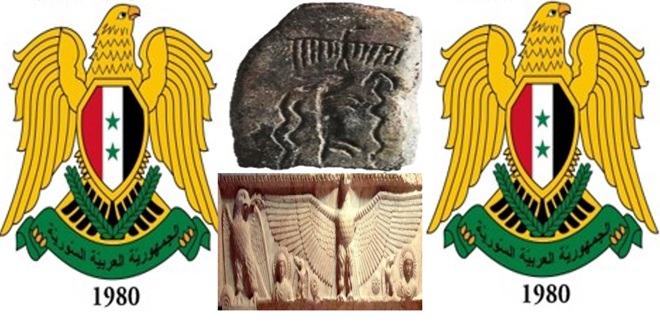
Syria is the first cradle for the launch of symbols from which the emblem of Al-Uqab spread to all parts of the world and became part of the global cultural heritage and a major element in artistic and literary beliefs and ideas.
The Historian Dr. Mahmoud al-Sayyed an expert in the Syrian archeology and ancient inscriptions at the General Directorate of Antiquities and Museums ( GDAM) , confirmed that the archaeological discoveries found in various Syrian archaeological sites document that the human being in Syria was the first in the world to carve Al-Uqab which is the king of birds of prey in the tenth millennium BC.
Al-Uqab bird was taken as a symbol of pride, vigor, self-esteem, courage, freedom, strength, sovereignty and loftiness, and its wings symbolize ascension, transcendence and strength as they embrace the vastness of the sky.
The researcher Al-Sayyed explained in a statement to SANA that Syria’s geographical location and the variation in its climate have characterized it by a biodiversity of plants and animals.
He indicated that Mount Sinjar, located on the Syrian-Iraqi border is today the source of the precious and rare Al-Uqab birds in the world, adding from the village of Rahiba (60 km north of the capital Damascus) free birds and rare falcons are priced to be adopted at the world level.
Al-Sayyed stressed that Al-Uqab represents part of the history of the Syrian environment and the biological balance in it. They have helped in the past and are still contributing in the present to maintaining the ecological balance by devouring animals.
He pointed out that the Syrian Uqab is the only one among the group of predatory birds which were discovered on the ancient Syrian coins and seals, and the large representation of Al-Uqab birds in the Syrian archaeological finds confirm that Syria, in light of the current archaeological data, is the pristine homeland of Al-Uqab .
Dr. Sayyed noted that in modern history, the Syrian Arab Republic is considered the first Arab nation to take Al-Uqab as its emblem so it became part of the nation’s history and a symbol of pride .
According to the Syrian antiquities expert, the study of the archaeological carvings affirm that the sculptor and the designer of the emblem depicted AL-Uqab , not the eagle or the smaller falcon as the emblem of the Syrian Arab Republic .
He indicated that in Al-Jarf Al-Ahmar and Mount Belaas sculptures, it is noted that the eagle is in the form of a large bird, graceful and quick to pounce, showing signs of pride, and has a sharp look.
The wings are spread wide as a symbol of the sublimity of the soul and the mind and to express a powerful, majestic predator with great looks while in flight.
The descriptions of Al-Uqab in all ancient Syrian sculptures are the same shape and features. In the carvings of Palmyra the image of Al-Uqab was carved with a large head and covered with feathers.
The body of Al-Uqab in the carvings of Palmyra was depicted with a long tail, and wide wings, thick and large feathers, and the feathers of the wings are strong, solid and arranged in a way that allows air to pass on the surface of the wing to help it fly long . It has large and sharp eyes on both sides of the head that enable it to see predators from long distances.
According to Law No. 37 issued by the late president Hafez al-Assad on June 21, 1980, and after its approval by the People’s Assembly on June 17, 1980 and its publication in the Official newspaper No. 26 in 1980, the emblem of the Syrian Arab Republic has become, up to to this day, consists of an Arab shield on which the national flag of the Syrian Arab Republic was engraved.
The shield embraces Al-uqab holding in its claws a ribbon on which the “ Syrian Arab Republic” is written in the Kufic script .
At the bottom of the shield are two spikes of wheat in golden color to form in addition to Al-Uqab , the ribbon, “a symbol of fertility and life,” .
So, the study of the Syrian archaeological finds and the emblem of the Syrian Arab Republic from 1945 until today document that Al-Uqab is the bird depicted in the modern and ancient sculptures discovered at the Jurf al-Ahmar site and the site of Jabal Balas , Palmyra sculptures, and the Syrian five thousand-pound banknote.
Al-Uqab bird, which is a symbol of strength, sovereignty, courage and pride, is the current emblem of the Syrian Arab Republic.
Rawaa Ghanam