
Indian Advocate to ST: President Bashar al Assad unflinchingly stood for the defense of Syria
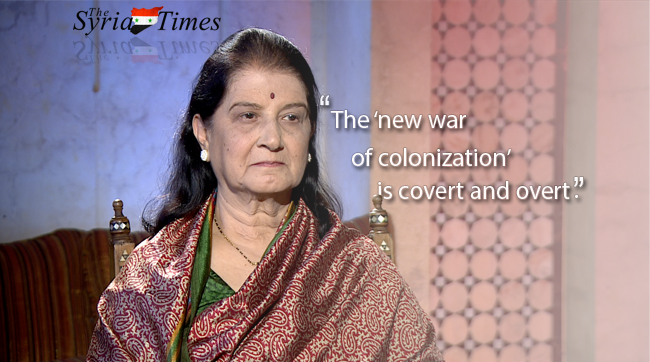
Indian Advocate Niloufer Bhagwat has made it clear that the US administration has failed for the second time to prevent the holding of the Syrian Presidential elections due to the resistance of the Syrian people , their unity, extraordinary courage and determination to stand behind the leadership of President Bashar al Assad, who unflinchingly stood for the defense of Syria as a nation and civilization President.
She told Syria Times e-newspaper in an interview conducted via e-mail: “During my visit to Syria in 2016 what amazed me was the capacity of the Syrian people to bravely carry on with their lives, despite the state of siege, and the destruction and the inhuman nature of the terrorist assault on the civilian population ,apart from the attacks on the Syrian armed forces. President Bashar al Assad, led by example in word and deed . The role of the Syrian armed forces and the people has been heroic.”
Bhagwat, who occupies the position of Vice President of the Indian Association of Lawyers in Mumbai, asserted that the victory of President Al-Assad in 2021 presidential elections was not surprising as President Al-Assad stood by the Syrian people and never left the country throughout the war on Syria.
“Syrians living in many European countries and in North America were not permitted by these governments to vote in the elections at the Syrian embassies ,in a feeble attempt to question the validity of the elections. Their propaganda has not succeeded. Today President Assad is acknowledged as one of the steadfast , courageous and wise leaders of the region and the world, an example to other heads of state,” she added.
The advocate referred to the fact that the Indian government has had cordial relations with the government of Syria headed by President Al-Assad; however the Indian response to the election of President Al- Assad is muted in view of the Indian government’s close ties with Washington, London and Tel Aviv, which limits its capacity for independent diplomatic initiatives, as is reflected in its not voting in the UN Human Rights Council on the issue of a Commission Inquiry into Israeli War Crimes and atrocities and exploitation of the Palestinian people .
Indian diplomacy
“Indian diplomacy is impacted by major Indian Corporate Sector houses and the Indian Oligarchs, who are members of US and British Foundations, and think tanks such as the Rand Corporation and the Council on Foreign Relations among others , as these Oligarchs are indebted to and financially dependent on investments from US Tech Companies and other US Corporations , Western Banks and financial institutions including London City and France among other European Banks and Corporations to whom they are indebted for investment and contracts , including to their armament Corporations for whom some of the Corporate Oligarchs are agents,” she emphasized.
Bhagwat went on to say: “The well heeled non- Resident Indians in the USA and Indian headed Companies in the United States and London have an increasing influence on Indian foreign policy . Israel also influences Indian diplomatic decisions, as Israeli Security and Tech Companies assist the present government in India in extensive internet surveillance of India’s citizens and India’s internal and external strategy and security. In view of these realities India despite good relations with Iran over decades, has had to fall in line and forego beneficial trade agreements with Iran and even earlier a proposed Iran- Pakistan-India gas pipeline which would have been a lifeline for Indian industry and energy.”
She underscored that India has failed to adequately leverage the good will it enjoyed in the Middle East and in Central Asia due to its close proximity to the US, Britain and Israel.
“When I was in Lebanon in 2018 in a town near the Israeli-Lebanon border on the Litani river , I was informed by local people that Mahatma Gandhi’s photograph was installed in their homes because of his outstanding moral and political stature and his unconditional support for the Palestinians and opposition to the settlement of outsiders on Palestinian territory when the policy of Zionist colonization of Palestine first began to be implemented by Britain . The policy makers in India are indifferent to the changes taking place in the Middle East with the decline of US military and economic dominance in the region.”
Sanctions
Moreover, Bhagwat stressed that sanctions are a declaration of war through financial and economic policy.
“With reference to the illegality of the unilateral imposition of sanctions, it should be understood that the UN Charter and International Conventions are not the only source of International Law . A large part of International law is what is known as Customary International law, legal practices which have evolved from the customary practices and norms adopted by states in their economic , military , diplomatic and other interactions over centuries to promote a mutually accepted civilized international system in the interests of all states , governments and peoples.”
“A large body of International Law, which has also evolved, is known as International Humanitarian law, which prohibits policies and practices which violate International Human Rights Charters and Conventions signed and ratified by most states including the United States and policies which adversely impact the civilian population in times of war. International Law prohibits harm being caused to the civilian population of countries even during war . One of the purported justifications for the WTO advanced by the Western countries and the rounds of trade negotiations between states, was to prevent any state from violating trade , economic and financial agreements between nations by resorting to policies which would amount to unfair economic means, adversely affecting fair competition and fair trade relations with the objective that all countries have a right to economic development as per resolutions of the General Assembly.”
She argued that unilateral Sanctions imposed by one country or a group of countries are wholly illegal .
 “The only exception provided in the UN Charter is when economic measures are permitted under Chapter VII against a country by a Resolution of the Security Council if it poses a threat to peace .
 Resolutions of the Security Council on Iraq and North Korea were wholly in violation of the UN Charter as Iraq devastated and defeated by the First Gulf War was no threat to peace and had no weapons of mass destruction . Neither was North Korea a threat , as US military contingents based in South Korea and the US war ships and nuclear submarines operating in and around the Korean peninsula are the real threat to the peace of the Korean peninsula. It is necessary to emphasize that as early as 2001 , the then President of the United States George Bush ( Jr) officially pronounced that all the six countries of the ‘Axis of Evil ‘were militarily targeted , this included Syria , Iran and North Korea which is the real reason these countries are illegally targeted by unfair sanctions to wage war against them by other means.”
The advocate explained that the reason behind absence of an article in the UN Charter or in any International Convention specifically prohibiting sanctions is the fact that the unilateral use of sanctions by any country or group of countries to impact civilian populations and governments has never been contemplated by the UN Charter . It now known all over the world which states pose a threat to peace and security and these belligerent powers have lost the moral high ground despite their propaganda apparatus in the global corporate media.
“Israel has over decades posed a serious threat to the peace and security of the Middle East and adjacent countries like Iran , yet the Security Council has not imposed by Resolution any sanctions on Israel, which is protected by powerful governments in the Security Council,” she affirmed.
Bhagwat referred to the fact that the abuse of the UN by the superpowers commenced in a bigger way after the capitulation of the USSR during the tenures of President Gorbachev and President Yeltsin, and after US advisers controlled the policies of Russia during the period of neoliberal economic reforms and earlier when the China entered into agreements for close strategic and economic cooperation with the US and European powers , with major US and European Transnational Companies shifting their manufacturing base to China in consideration for China not opposing the military and strategic interests of the United States around the world.
She in addition indicated that the importance of the Middle East for US policy is related to the hydrocarbon resources of the region.
“To retain the dollar as the global reserve currency despite the massive debt of the US economy, it was necessary to politically and militarily control every oil producing country in the Middle East and adjacent regions and to dominate those countries with strategic potential for hydrocarbon pipelines. This is the real reason for the wars waged against the countries in the Middle East by the United States,” she concluded.
Interviewed by: Basma Qaddour