
Damascene Oud – Part of the Syrian Musical Heritage
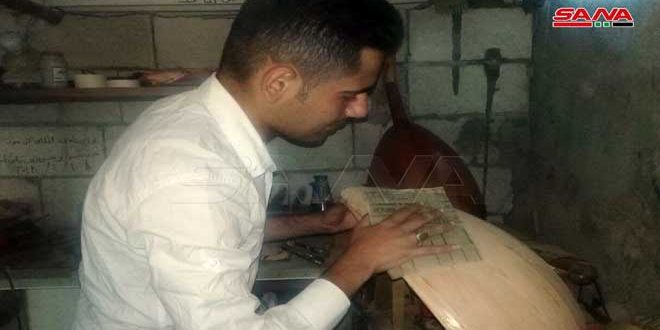
The Damascene oud is one of the most important components of Syrian intangible heritage and has an international reputation characterized by its precise handicraft and smooth sounds that generate original music. The oud is one of the oldest oriental instruments and Syria is considered its cradle.
The young Syrian man Hasan Zahra is working hard in his small workshop in one of the villages of Sheikh Badr in Tartous to develop his profession in making the oud, which he learned about three years ago. He uses simple tools including a saw, a file, a drill, and a knife with smoothing tools.
Zahra told SANA that he began to make the oud after he mastered playing it, taking advantage of social media to learn how to play it, indicating that he produces about 10 instruments during one year.
He said: “My love for this instrument and my inability to buy it previously prompted me to learn this profession, which is rarely spread among the young generation.”
 The twenty-year old man explains the stages of making the oud which begins with the manufacture of the sound box, consisting of 14 or 16 blades, 75 cm long and 4 cm wide, with a thickness of half a cm, then the stage of smoothing, followed by the stage of installing the face on the box and the key box. After that painting the lute with lacquer, then installing the strings made of plastic in length and specific thicknesses.
Zahra works on introducing mulberry, fir, beech and walnut wood in this industry to give it a special luster, considering that the oud made of walnut wood is the best in terms of durability, shape and purity of sound.
He believes that the oud maker should be precise and patient in his work, as this industry requires sufficient time to obtain an instrument of beautiful shape and sound with high specifications.
Zahra, who contacted a number of oud players and experienced people who expressed their admiration for his work, aspires to be distinguished and famous in order to market his oud making all over Syria after he managed to sell several instruments in the governorates.
He hopes to move from his small workshop and his humble tools to a fully equipped factory to develop this profession more , especially after he made two Bezouk instruments and a guitar. He stressed that he seeks to motivate the younger generation to learn to make musical instruments that are attached to the Arab heritage.
Rawaa Ghanam