
Dr. Shaaban: Unilateral coercive measures amount to a crime of collective punishment against the Syrian people
The Presidential Political and Media Advisor, Dr. Bouthaina Shaaban has stressed that the unilateral coercive measures and the siege imposed by the United States on millions of innocent Syrian civilians are illegal and they reflect the tyranny practiced by a dominant military force against the peaceful people of a country, which is a founding member of the United Nations and which has opened its doors to all who have been subjected to injustice throughout history and has sought attaining a safer, more stable and peaceful world.
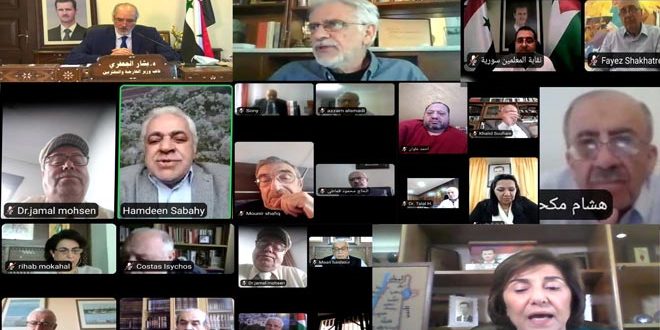
Dr. Shaaban was speaking during the Arab International Forum for Lifting the Sanctions Imposed on Syria held online by the International Arab Center for Communication and Solidarity in Beirut and the Arab National Conference.
She criticized the misleading colonialist language being used by the United States and the European countries to describe these sanctions as targeting specific people, whereas, in fact, they affect every child, woman, youth and elderly in Syria and harm the sectors of health, education, food, agriculture, industry, the country’s identity and civilization and the thousands of years old lifestyle in the country.
Dr. Shaaban affirmed that the unilateral coercive measures, known as “Caesar Act”, in addition to other sanctions imposed on Syria amount to a crime of collective punishment against the Syrian people, particularly after ethnic cleansing crimes have been committed against some categories of the Syrian people that have lived in peace and amity on the land of Syria for thousands of years. “Therefore, those who support these sanctions or keep silent over them are participants in this crime,” she said.
The presidential advisor pointed out that the United States, as an occupation power in the northeast of Syria, is stealing Syrian wheat and oil and depriving the Syrian people of their own resources in order to tighten the noose on them.
She asked “how long will it take for the global conscience to wake up and work hard to put an end to such criminal practices and achieve justice to the peoples who are exposed to occupation, terrorism and sanctions that are tantamount to a terrorist and economic war?”.
On his part, Ma’an Bashour, Head of the Arab International Center for Communication and Solidarity, said that the so-called (Caesar Act) violates all laws, calling for forming an Arab international commission for confronting the siege and lifting the sanctions imposed on the Syrians.
Secretary General of the Arab National Conference Majdi Al-Maasarawi asserted that the blockade is a form of aggression and that the aggression against any people is an aggression against all humanity. He stressed that the Arab people, parties, unions and popular commissions won’t hesitate in supporting the Syrian people, army and leadership even if their governments don’t do their duty in backing Syria’s counterterrorism efforts.
Head of the Lebanese “Al-Marada” Movement Suleiman Frangieh said that attempts to target Syria are part of a broader scheme to target the Arab identity and fragment the region’s countries.
He pointed out that the Syrian state has managed, over the past decades, to solidify its historical, geographic and political position, stressing that the forthcoming presidential elections in Syria are an essential step through which Syria confirms its option and decision and stresses its sovereignty and unity.
Archbishop Atalllah Hanna of Sebastia for the Greek Orthodox in Al-Quds voiced solidarity with Syria which has always been a staunch supporter for the just Palestinian cause, urging the immediate lifting of the sanctions imposed on Syria and the canceling of the so-called “Caesar Act”.
He added that after failing in undermining Syria through a terrorist war, Syria’s enemies started a new conspiracy through trying to starve the Syrian people, and they want to achieve- through this economic war- what they couldn’t achieve through terrorism and military action.
The forum will hold another session next week in which non-Arab politicians and intellectuals will take part.
Hamda Mustafa