
Sabbagh: Some countries ignore disastrous effects of coercive measures imposed on Syria
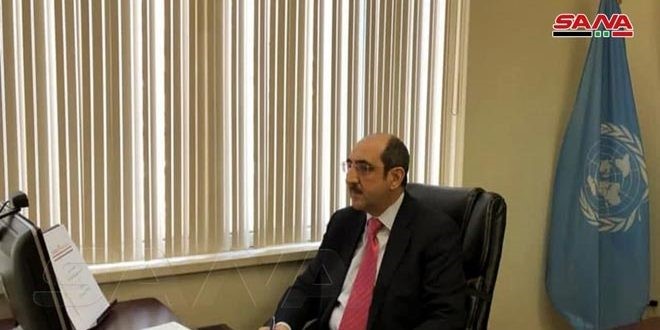
On March 29th, Syria’s Permanent Representative to the United Nations Bassam Sabbagh said that some member states of the Security Council deliberately ignore the disastrous effects of the unlawful coercive measures they have imposed on the Syrian people.
Sabbagh said these disastrous effects show that these member states are not looking for humanitarian work in Syria, but rather to achieve political goals by employing and exploiting the humanitarian situation.
During a video session of the Security Council, Sabbagh said that these countries continue to use and exploit the platform of the Security Council to politicize humanitarian work in Syria and the discussions related to it and to promote a selective view of the humanitarian situation.
Sabbagh said that these state’s data focused on what serves their goals, including their endeavor to extend the mechanism for the introduction of cross-border aid.
Sabbagh said that it would have been more useful for the delegations of those countries to take advantage of this high-level meeting to disavow their failed policies during the past ten years and give priority to humanitarian considerations over their narrow interests.
Sabbagh said: “ It would have been more appropriate for the Security Council to oppose those who hinder the Syrians from fulfilling their economic capabilities and to demand from the United States to end its occupation of Syrian lands, stop its support for separatist militias, stop the operations of plundering Syrian wealth. The UNSC has to demand the Turkish regime to withdraw its forces from Syrian lands.”
Sabbagh stressed that the world is now realizing that this data is only part of a campaign to mislead the public opinion to convince it that these countries have nothing to do with what Syria has reached after ten years of the terrorist war.
Sabbagh said: “ They want those who listen to their statements to believe that the unlawful unilateral coercive measures imposed by these countries on the Syrian people, the last of which is the so-called “Caesar Act,” do not represent economic terrorism and collective punishment and have nothing to do with the economic crisis that the Syrian people are experiencing.”
Sabbagh said: “They want us to believe that the so-called “Brussels Conference” held today is a forum to help the Syrians, while it is a mere showcase event that is useless in the absence of the Syrian state and a platform to attack Syria and to offend it.”
Sabbagh added, “We were looking forward that the briefing of the UN Under-Secretary-General for Humanitarian Affairs, Mark Lowcock, to be more balanced. We hoped that he would refer to the great efforts exerted by Syria to facilitate the delivery of aid and to the rocket attack by Turkish-backed terrorist organizations’ against the city of Aleppo that caused the death of two civilians and injuries, including children.”
Sabbagh stated that the stances of some countries, led by the United States, do not help in any way to improve the humanitarian situation in Syria.
Sabbagh reiterated that the center of humanitarian work in Syria is Damascus and not any other city in the neighboring countries or beyond.
Sabbagh said: “This is the simplest thing that means respecting the principle of Syria’s sovereignty, unity and territorial integrity, which is affirmed by all relevant United Nations resolutions.”
Sabbagh indicated that Syria has repeatedly expressed its serious concerns about the mechanism of cross-border delivery of aid, especially with regard to its violation of the principle of Syria’s sovereignty and territorial integrity and to the restrictions on humanitarian work established by General Assembly Resolution No. 182-46.
He said that Syria is keen to meet the needs of its citizens on all its lands and to strengthen the mechanism for the delivery of aid across borders to support the improvement of the humanitarian situation.
Sabbagh pointed out that there are a number of grave flaws accompanying the implementation of the delivery mechanism of cross-border aid.
Sabbagh indicated that the United Nations Office for the Coordination of Humanitarian Affairs (OCHA) in the city of Gaziantep does not abide by the work controls stipulated in the United Nations Charter.
Sabbagh said that the distribution mechanism represents the most dangerous aspect in the process of the aid delivery across borders due to the lack of transparency and identification of the third parties or partners to whom OCHA refers in its reports.
Sabbagh pointed out that Syria and its commitment to deliver humanitarian aid to all regions, including across borders, stresses the importance of the humanitarian corridors that are opened in cooperation with Russians, including the one recently opened in Saraqib.
Sabbagh emphasized that the Security Council discussions cannot achieve progress through provocative statements and the use of “inappropriate and sometimes rude” phrases.
“Progress is only possible through open and constructive dialogue based on mutual respect among member states and taking into account the views of the country concerned with the discussion,” Sabbagh concluded his statement.
Inas Abdulkareem / O. al-Mohammad