
Syrian calligraphers participate in virtual silk road calligraphy conference
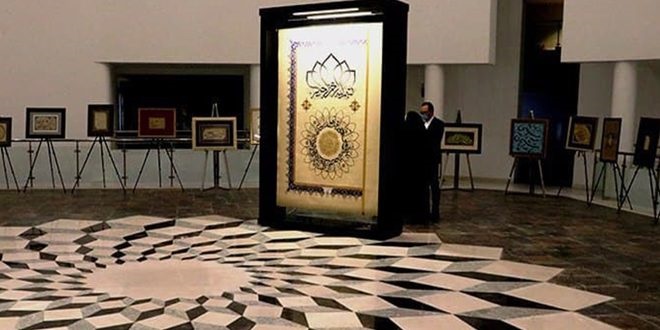
The first virtual international exhibition and the Silk Road Calligraphy conference, which is being held in Iran, aims to display the quotes of prominent figures, messengers of goodness and friendship , the connection between the calligraphers of the world and the elimination of the thought of war in the human mind.
The Syrian participation in the event is characterized by bringing the pioneers’ works of Sham school in calligraphy who had the favor in this art all over the world.
 Regarding Syrian participation organized by the House of Arabic Calligraphy and Arts Association in cooperation with the Iranian Cultural Center in Damascus, the calligrapher and plastic artist Reem Qubtan, head of the association, said in a statement to SANA that the participation included 20 works by seven of the pioneers of Sham School in Arabic calligraphy.
Qubtan explained that the term Sham school is not specific to the city of Damascus only, but rather reflects the Syrian school in Arabic calligraphy.
The Syrian participation in the conference, according to Qubtan , also included presenting a research paper on ornamentation, gilding, and poetry and their importance in making beautiful and decorating manuscripts and books, especially the Qur’an Sharif .
 She underscored that Syria’s participation aims at showing the importance , beauty and distinction of Sham school in calligraphy arts and opening new horizons for Syrian calligraphers by examining the experiences of other countries in this field and creating civilized dialogues that express Syrian heritage, civilization and cultural identity.
It is worth noting that the conference and the accompanying exhibition opened on January the 20th at the Khorasan Museum in the Iranian city of Mashhad and it will last until the 28th of this month.
More than 230 works from about 40 Arab and foreign countries including Iran, China , the republic of Azerbaijan, Afghanistan, Iraq India, Pakistan , Egypt , Kuwait, Russia, Turkey, France and Spain were exhibited at the event . The participating countries today along the historic land and maritime Silk Roads, all still bearing witness to the impact of these routes in their cultures, traditions and customs.
Rawaa Ghanam