
Archaeological Imperial Temple in Shahba a Witness to Great Civilization in Syria’s Southern Region
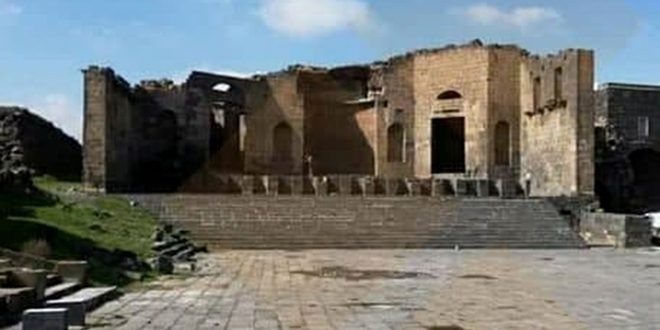
In the city of Shahba to the north of Sweida , the Roman Imperial Temple stands as a model of ancient architecture and its walls tell a history dating back thousands of years.
Archaeologist Hassan Hatoum told SANA that the Roman Imperial Temple represents a large and organized architectural collection around a large and paved square located to the southwest of the main Roman road (Decumanus) which was an East-West oriented road.
He pointed out that the French archaeologist Melchior de Vogue’ named in 1865 this unique architectural monument and a series of other religious buildings in the region as (Kalepe). This term denotes religious buildings dedicated to the dwelling of the gods or their statues.
Hatoum indicated that the General Directorate of Antiquities and Museums acquired in 1974 the houses that covered the large part of this archaeological building, which contributed to showing the original remains of the building.
 The archaeologist noted that many archaeological excavations and restoration work took place to highlight this historical building . The façade of the 30-meter-wide building, which overlooks the square from the western side, has been uncovered containing three rooms. The middle of which is a large ( mehrab) niche , topped by a dome and preceded on the eastern side by a large platform similar to the stage of the theater and its front façade is decorated with semicircular niches . This platform overlooks another platform with the same width of the façade and ends with a staircase that goes down to the large paved patio.
He added that the archaeological excavations uncovered domed architectural columns on which the platform and stairs were based.
It is noteworthy to mention that Shahba city includes many important archaeological monuments that are still present till this day, mainly the Roman theater, the great archaeological baths, the (Filipino) cemetery, which was built as a funeral temple for the family of Emperor Philip the Arab, in addition to Shahba Museum, which contains many mosaic paintings and the Roman Imperial Temple..
Rawaa Ghanam