
Biological clocks ‘beat quicker’ in cities
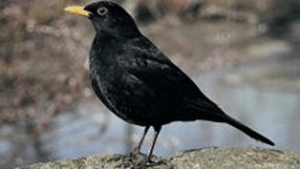
City living could have a major impact on the biological clocks of humans and animals, a new study has found.
Researchers measured the circadian rhythms – the 24-hour cycle of biological activity – of urban and rural blackbirds in southern Germany.
German and Scottish researchers found the city birds woke up earlier and rested less than forest dwelling birds.
The team has raised the possibility the differences could be the result of micro-evolutionary changes.
The study, which has been published in the journal Proceedings of the Royal Society B, was carried out by Glasgow University and the Max Planck Institute for Ornithology in Germany.
A number of adult male European blackbirds were captured from Munich and a nearby rural forest.
Each bird was equipped with a lightweight radio-transmitter which monitored their daily levels of activity in the wild for 10 days before they were recaptured.
“Our work shows for the first time that that when sharing human habitats, a wild animal species has a different internal clock”.
They were then kept in light-proofed, sound-insulated chambers and their circadian rhythms were measured under constant conditions
Once the tests were complete the birds were returned to the wild
Dr Barbara Helm, from Glasgow University’s institute of biodiversity, animal health and comparative medicine, said: “We found that the rhythms of urban birds in the wild differ significantly from their forest counterparts.
“On average, they began their daily activities around 30 minutes before dawn, while forest birds began their day as the sun rose.
“The city birds ended their days around nine minutes later, meaning they were active for about 40 minutes longer each day”.
Dr Helm said in “constant laboratory conditions” the circadian rhythms of urban birds were clearly altered”.
“There seems to be a different beat to city life”, she said. “City clocks were also less persistent, especially in the business district”.
The team said its research added “to a growing consensus” that towns and cities “have a profound effect on the internal clocks” of humans and animals
It said further study was needed to determine whether these changes could lead to increased health problems or were related to better function in urban areas.
Dr Helm added: “Previous research undertaken by other researchers has suggested strong links in humans between disrupted sleep patterns and an increased incidence of depression and diseases including obesity and some types of cancers.
“Our work shows for the first time that when sharing human habitats, a wild animal species has a different internal clock.
“We’d be keen to find out the costs and benefits of modifying biological rhythms in blackbirds and other animals commonly found in our cities. This may help us to better understand the challenges of coping with urban life”.
The researchers have raised the possibility the differences in the biological rhythms could be the result of micro-evolutionary changes in response to urban phenomena such as artificial light and increased noise levels.
Source:BBC
N.H.Khider