
Distinctive Syrian Icon… plastic artist Ghassan Jadid
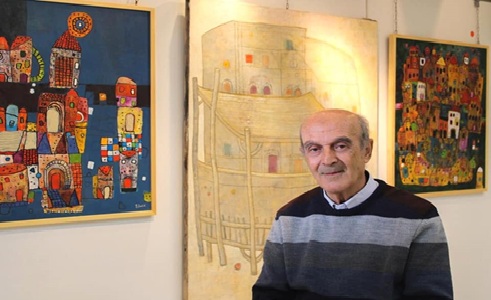
Although the features of Tartous changed and lost many of their original beauty , the artist’s burning memory and the spirit of the rowdy child that did not leave him, denied this change, and kept everything as it was… This is the Knights’ Hall, which was turned into a square, and here is the cathedral that has become a museum. Tartous Tower, the ancient windmill, the Roman port, and the old wall of Tartous, which was used by sellers of almonds, apricots and pistachios. He is Ghassan Jadid, the child who is discovering the alleys and lanes of his city again.
“A work of art is an awareness of emotions, thoughts, desires, safety, anxiety, and ideals. In other words: it is an expression of life, therefore, it is wrong for people to see painting with their minds, because art is suffering, and I personally paint for myself, in a way that others can understand.” With this idealistic and noble vision, the Syrian plastic artist Ghassan Jadid describes the artwork that he produces and presents to people.
 The first beginnings of Ghassan Jadid’s experience goes back to the late sixties of the last century, when he was a student at the Faculty of Fine Arts at the University of Damascus.
In 1971, Ghassan left the photography department at the College of Fine Arts, with a distinguished graduation project, in which the artist combined the human figure and the symbols of the sea, in a manner that oscillated between several contemporary artistic trends. Most of it taken from prominent modern international photography icons, such as Picasso, Paul Klee, Kandinsky, Juan Miro… and others. In addition to the influences that he received from several unique Syrian plastic experiences of genius artists who taught him at the Faculty of Arts in Damascus, especially Fateh Al-Mudaris, and Louay Kayali.
He believed in the necessity of searching for differentiation and creating a personal artistic identity, so he adopted the realistic, expressive and spontaneous artistic formula that he worked on and still has been working on for more than forty years of time, without being damaged by repetition, either in subject or in formulation.
Talking about his paintings, artist Jadid says, “My paintings are the true expression of my inner self. They are my personal adventures.
Painting for me is like a wide sea, where I throw myself though I am not sure what I will encounter next. I may start with an idea and then end with a different painting. For me, painting is an artistic adventure with endings that may not resemble the beginnings. In general, I usually keep key elements that I recreate each time on my canvas.
I am not like anyone, and even if someone draws in the same way as I do in form and color , my touch remains unique”.
Jadid went on to say, “each painting has its own atmosphere, and its own color mood, and every color that I use imposes on me another color that may be in harmony or contrast with the color that preceded it. I think that the color is the element that shows the sensitivity of the artist, indicates his mood, and confirms his ability and the strength of his brush. I usually use hot and cold colors and in between without any reservation or hesitation, but I admit that black is my first enemy in painting because it affects the aesthetic of the painting, so I do not use it unless I have to. Sometimes I replace it with white whenever possible, and color in general is my main component in conveying the idea.
Concerning the subjects of his paintings, the artist said, “I’m not good at drawing pain. I open the windows wide in front of my drawings so they look like children’s drawings. I search in my memory for ancient details and try to convey the astonishment of the first discovery, innocence of ideas, and the wildness of the childish imagination, and then I color it just as children color their imaginations. In my paintings, the sky can be green, the sea yellow, and the sun pink”.
Ghassan Jadid continued to describe, without limits, through bright lines and colors, the memories and dreams that flashed inside him by the influence of beautiful objects and scenes in the coastal cities. The sea and its traveling moon between two blueness, the whispering marine spirits inhabited by awe, mystery and magic, in addition to his visual memory which is rich with symbols, signs and shapes borrowed from the ancient civilizations.
His paintings provide the viewer with charming visual messages, in which the old and the modern, order and chaos, the heavenly and the earthly, the real and the imaginary coexist.
During the past four decades, Ghassan Jadid’s artistic experience was based on a spontaneous and innate composing for the homes of his hometown (Tartous), especially its old museum. It appears in almost all of his paintings, making it one of his main amulets or as an artist’s signature on them, as this element belongs to Ghassan Jadid alone, not any of the Syrian photographers.
Badie Jahjah, Director of the Alf Noun Gallery for Plastic Art, said: Ghassan Jadid represents an important component of the memory of Syrian plastic art. He is a contemporary of all the pioneers and lived a beautiful experience with an artist who is one of the most important of them, Louay Kayali.
Jahjah considered that the artist Ghassan Jadid represents a special case in Syrian plastic art, where the concept of freedom and commitment is intertwined. He referred to the apparent intermingling of the dialogue formed by the sea waves on the shores of Arwad and those colorful windows that appeared in Ghassan’s paintings. Those windows that hide songs, covered them by a line between black and white, and scattered them in the form of shapes and worlds that resemble nothing but Ghassan.
The plastic artist, Saleh Al-Khader, who is a student of Jadid, said that the artist has a rich and valuable artistic experience, as he draws inspiration from the old Tartous and adds elements and colors of joy with different techniques that carry a lot of love, happiness and the artist’s inner anxiety.
Al-Khader, two years ago, held an exhibition entitled, Greetings to Ghassan Jadid, hosted by the Al-Adiyat Association in Tartous.
Ghassan Jadid was born in Tartous, 1946. He graduated from the Faculty of Fine Arts in 1971. He worked for the Directorate of Education in Tartous for 15 years.
He participated in the official spring and autumn exhibitions since 1965.
He has many participations in individual and group art exhibitions inside Syria and abroad.
Prepared by: Amal Farhat