
9th Round of Astana Talks on Syria Kicks off
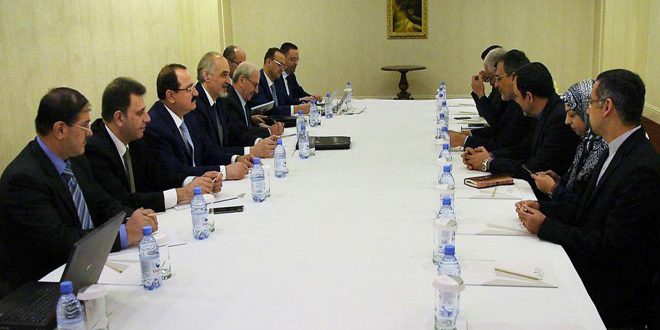
ASTANA, (ST)- The ninth round of Astana talks on Syria started on Monday at the Kazakh capital with the participation of delegations representing the guarantor countries (Russia, Iran and Turkey), the Syrian Arab Republic delegation and the opposition delegations.
The Syrian Arab Republic delegation, led by Dr. Bashar al-Jaafri, held a meeting with Hussein Jaberi Ansari, the Iranian Assistant Foreign Minister for Political Affairs and the head of the Iranian delegation to the talks.
The two sides discussed items on the agenda of this round of talks and the continuity of consultations and coordination. They focused on the Turkish regime’s violations of international laws and charters, items of some Astana agreements and the need to continue the fight against terrorism
The Syrian government delegation also held a meeting with the Russian delegation led by Alexander Lavrentiev, the Russian President Special Envoy for Syria.
Lavrentiev: Non of the de-escalation zones is cancelled
 The Russian delegation also held meetings with each of the Iranian and the Turkish delegations.
According to Lavrentiev, Moscow doesn’t consider any of the de-escalation zones as cancelled.
Russia Today quoted the Russian diplomat as saying to journalists in Astana on Monday “We don’t believe that any of the de-escalation zones has ceased to be existed..there is a kind of planned change within the framework of peaceful settlement in Syria.”
Lavrintiev affirmed that the US absence in this round won’t affect the talks which aim at achieving more stability in Syria.
According to Sputnik, he said that “the process is progressing as planned and head of the delegations of the guarantor countries are implementing the directives of their governments”. He pointed out that nobody doubt the viability of Astana process in achieving more stability in Syria except the United States and its allies, therefore its absence won’t affect the talks.
He expected that the guarantor countries will issue a joint statement at the end of this round of talks that includes an assessment of the results of the work of the parties concerned in the Astana process and a future plan.
During the talks, the parties are due to discuss the current situation in Syria, including in the de-escalation zones, humanitarian issues and confidence-building measures and coordinate further steps to facilitate the resolution of the crisis in that country. Bilateral and multilateral consultations are scheduled to be held today, while the plenary meeting is to be held on May 15.
Hamda Mustafa