
70 Syrian Pharmaceutical companies ensure about 90% of the need of local market
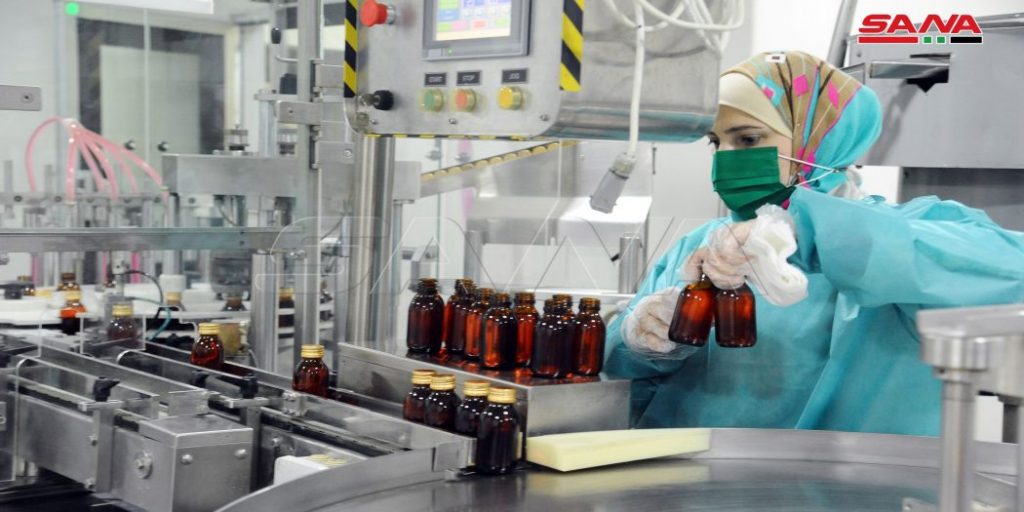
Medicine Industry sector in Syria has exerted every possible effort to overcome the challenges resulted from the Western coercive measures being imposed on the country and the impacts of the terrorist war which targeted the industrial sector in general.
According to a report published by the Syrian News Agency (SANA), the government has adopted a package of measures to support this significant industry and attract investors in an attempt to enable the pharmaceutical industry in Syria to restore its previous position and develop it.
Director-General of the Syrian Investment Authority Madian Diab asserted the government’s keenness on meeting the needs of the factories concerning raw materials , referring to the importance the investment law No.18 in offering facilities, creating competitive investment environment, attracting capitals, and benefiting from expertise, in addition to increasing job opportunities and raising economic growth rates in order to reach a comprehensive and sustainable development.
Diab added that the number of health and medical and pharmaceutical industry projects that were carried out between 2017 and 2020 reached 17 projects with a cost estimated at SYP 16 billion which are scheduled to employ over 2000 workers, indicating that the projects were carried out in Damascus Countryside, Lattakia, Homs, Tartous, Sweida and Hama, while three projects of them were carried out in Lattakia and Tartous.
For his part, Chairman of the Scientific Council for Pharmaceutical Industries, Dr. Rashid Al-Faisal said that the local medicine factories ensure about 90 percent of the need of the local market through 70 factories that are currently working in Damascus countryside, Aleppo, Homs, Hama. Tartous and Lattakia.
“10 Pharmaceutical companies became out of service after they were damaged during the crisis, while 20 licensed companies are under construction, “ Al-Faisal srated.
The pharmaceutical industries in Syria was covering more than 93 percent of the needs of the local market before the start of the crisis in the country and the factories were exporting their productions to 54 Arab and foreign countries.
Basma Qaddour